


In 2024 almost a third of data breaches were the result of third-party access to corporate data (2024 Verizon Data Breach Investigation Report – DBIR) third-party risk management (TPRM) has emerged as a critical component of organizational cybersecurity strategy in today’s interconnected business environment. Establishing a robust TPRM framework essential for protecting sensitive data, maintaining regulatory compliance, and preserving organizational reputation.
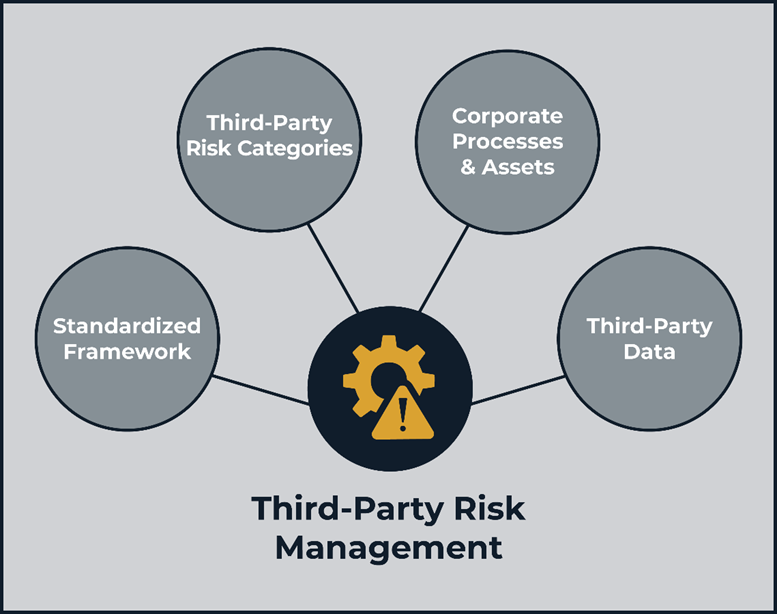
Third-Party Risk Categories + Corporate Processes/Assets + Third-Party Data + Standardized Framework = Third Party Risk Management
Understanding Third-Party Risk Categories
Companies must evaluate multiple risk categories when assessing third-party relationships. Cybersecurity risks represent the most prominent concern, encompassing data breaches, malware infections, and unauthorized access due to weak vendor security measures. However, a comprehensive TPRM program must address additional risk domains:
- Operational risks involve potential service disruptions, downtime, or business continuity failures that could impact daily operations. For example, a healthcare clinic relying on a single medical device supplier faces significant consequences if that vendor suddenly ceases operations. A University relying on third party SaaS providers for their Learning Management System risks having to stop teaching classes if there is significant downtime.
- Compliance risks exist for vendors failing to adhere to regulatory requirements such as FERPA, GDPR, HIPAA, or SOC 2. These failures can result in regulatory penalties and legal liability for the primary organization because compliance liability cannot be delegated.
- Financial risks include vendor bankruptcy, fraud, or financial instability that could affect service delivery and contractual obligations. Organizations must assess the financial health and sustainability of their critical vendors.
- Reputational risks arise from public relations damage resulting from a vendor’s security lapse, ethical violations, or poor business practices. These risks can have long-lasting impacts on stakeholder trust and market position.
Understanding Your Corporate Processes and Assets
Documenting critical businesses processes and data are the essential first step to understanding third-party risk. Hardware, software and data should be inventoried and classified (types of classification are a future topic). For example – the employee payroll process is a business critical process that contains personally identifiable information (PII) demanding a higher level of protection. Alternatively, press releases that have already been published are public information. Third-party vendors/partners should be classified by the highest level of business processes and data that they handle.
Companies should use this understanding to evaluate the different categories of third party risk and set a risk tolerance. It’s important to apply higher levels of protection on the payroll process then public press releases. This conclusion can only be reached by comprehensively understanding corporate processes and data.
Creating and Reviewing Perspectives on a Third Party
Homebuilding involves multiple perspectives. There is a plumbing layout and an electrical layout for example. Similarly, effective third party risk management requires multiple perspectives. Two of those perspectives are:
- Policy and procedure reporting. Documentation provided by the third-party around their operations, cybersecurity, compliance and financials.
- Third party evaluation of operations. This perspective includes third party audits, penetration testing results, and monitoring of external assets and news.
The combination of policy and procedure reporting along with third party evaluations are used to produce a current picture of the third party vendor/partner under examination.
Policy and procedure reporting can be completed by providing access to documentation via a company’s trust center, or uploads of internal information security documentation (e.g. access control policy). Third party evaluations should be a combination of “in-time static” and continuous. A penetration test or audit are point-in-time static views that accurately represent, but are subject to change immediately after the assessments complete. Continuous evaluations are near-real-time on-going assessments that refresh periodically. A daily review of news about a third party vendor is an example, and monthly external vulnerability scans of Internet exposed assets is another.
Mapping Third-Party Data to Standardized Frameworks
Corporate risks for cybersecurity can be further decomposed into specific domains for examination and easier management. There are numerous standardized frameworks available for organizing those domains, including, but not limited to:
- NIST Cybersecurity Framework Rev 2 and 800-53
- NIST 800-161 Rev 1
- Center for Internet Security (CIS) critical controls version 8.1
- ISO 27001 supply chain requirements
NIST CSF 2.0 provides guidance for third-party risk management through its Govern Function. Key practices include establishing supply chain risk management strategies and objectives (GV.SC-01), integrating third-party risk management into enterprise risk management processes (GV.SC-03), monitoring supplier risks throughout the vendor relationship lifecycle (GV.SC-07), and including suppliers in incident response and recovery planning (GV.SC-08).
The framework emphasizes building unified governance structures, prioritizing critical vendors (which can only be completed once a company understands it’s critical business processes), implementing continuous monitoring, and measuring risk outcomes. The other functions in NIST CSF are Identify, Protect, Detect, Respond, and Recover – and third-party operational evaluation data can be mapped to the requirements here, or in the related NIST standard NIST 800-53 that has more detailed requirements.
NIST SP 800-161 provides specific guidance on cybersecurity supply chain risk management (C-SCRM) practices. This framework integrates C-SCRM into organizational risk management activities through guidance on developing C-SCRM strategies, implementation plans, policies, and risk assessments for products and services.
CIS Critical Security Controls version 8.1 can be used to map vendor data to the relevant controls— service provider management, governance, asset inventory, and continuous monitoring.
ISO 27001 Annex A controls 5.19 and 5.21 specifically address information security in supplier relationships. Organizations must identify and document information security obligations toward suppliers and partners, incorporate specific security measures into supplier contracts, and regularly assess vendor security practices through audits or self-assessments. The standard requires establishing standardized approaches for supplier assessment and selection based on security requirements, continuous monitoring of existing supplier relationships, and clear communication channels for managing security incidents.
Implementation Best Practices
Organizations should establish a cross-functional TPRM team involving representatives from risk management, operations, procurement, finance, IT, cybersecurity, legal, and compliance departments. This collaborative approach ensures comprehensive risk evaluation and stakeholder buy-in. Rhindon Cyber vCISOs regularly lead cross-functional team for companies.
Identification of business critical processes and data shared with vendors enables companies to allocate resources efficiently. High-risk vendors requiring access to sensitive data or critical systems should undergo more extensive due diligence and continuous monitoring than low-risk suppliers.
Continuous monitoring capabilities for critical vendors should include real-time threat intelligence, vulnerability scanning, and dark web monitoring. Modern platforms leverage artificial intelligence to autonomously drive risk discovery and remediation while identifying fourth-party “shadow” vendors. Rhindon Cyber offers all of these services for customers.
Contractual controls must include specific security and regulatory requirements, right-to-audit clauses, incident notification obligations, and clear data handling provisions. Contracts should also address service level agreements, business continuity requirements, and vendor termination procedures. For example – every contract should have an attestation clause on removing corporate data and backups upon contract cancellation.
Measuring Program Effectiveness
Successful TPRM programs require quantitative risk scoring based on objective criteria such as vulnerability management performance, incident history, and regulatory compliance status. Companies should implement key performance indicators (KPIs) to track vendor performance throughout the relationship lifecycle. Not every third party requires continuous monitoring, but it is an effective risk reduction activity for critical vendors and partners.
Regular reporting to executives, boards, and regulators demonstrates the value of integrated third-party risk management and supports data-driven decision-making. Analytics should provide actionable insights about vendor risk trends, concentration risks, and program maturity. Third-party risk management has evolved from a compliance checkbox to a strategic business imperative. Organizations that implement comprehensive TPRM frameworks by adopting some of the established standards mitigate risk and enable opportunities for innovation and growth. The investment in robust third-party risk management ultimately protects organizational assets, ensures regulatory compliance, and maintains stakeholder trust.
David Mosher is CEO & Founder of Rhindon Cyber, providing vCISO services securing financial service firms, high net worth individuals, Catholic non-profits and the small and medium business market. He holds an MS in Cybersecurity and is currently pursuing a PhD in Cybersecurity Management.